
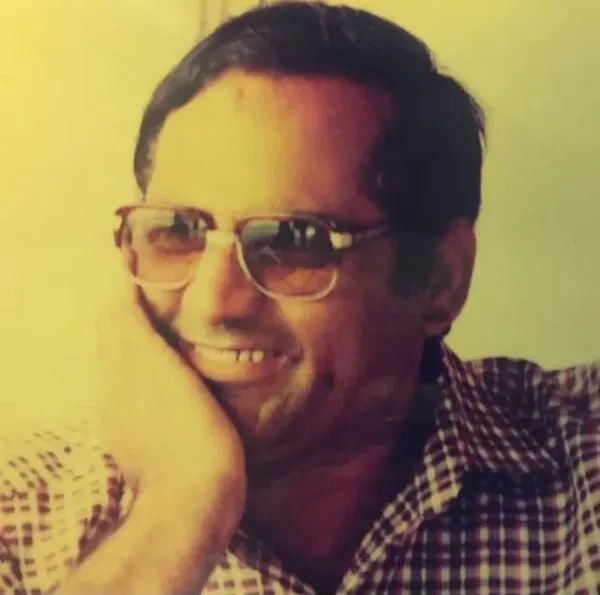
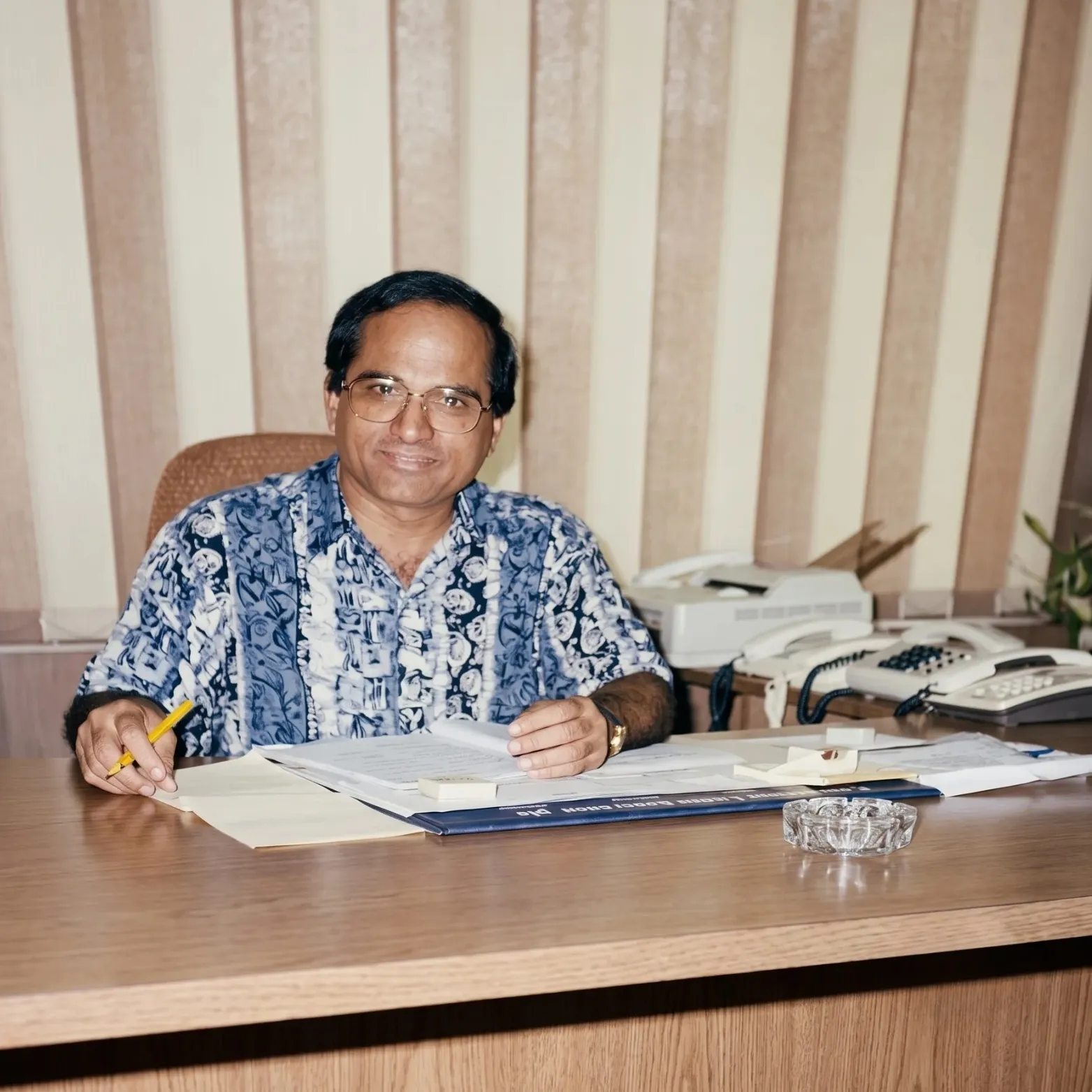
In the mid-1990s, a profile of Hanif Rajput in The Herald Annual opened inside his air-conditioned office on the mezzanine floor of Society Apartments, where some thirty staff worked the phones running an operation that, by then, touched almost every major city in Pakistan. It was a striking image for a man who, barely a decade earlier, had been selling soft drinks from a wooden chair by the KMC swimming pool. That contrast — between the modest, small-town clerk and the man everyone in Karachi now knew simply as Hanif Rajput — is the whole of his story.
He wasn't born Hanif Rajput at all. His name was Muhammad Hanif; the surname was added almost by accident, when an immigration officer in London couldn't get his name right and settled, instead, on his father's name.
A small-town boy with an organiser's instinct
Rajput was born in 1944 to a lower-middle-class family in Rohtak district. Just before Partition, the family resettled in Nawabshah, where they still live today — and where, despite everything he later built, Rajput has always insisted on keeping his small-town simplicity. Colleagues who worked with him for years would later remark that they never once saw him fire anyone, however serious the mistake, and that he worked harder than the people under him rather than acting like a boss.
He never set out to become a caterer. As a boy, he wanted to be an aeronautical engineer. His organisational streak showed up first in the boy scouts at Islamia High School, Nawabshah, where he was consistently the top scout in his group and, at various jamborees, found himself put in charge of arranging meals simply because he was good at making do with limited resources and covering up the gaps. That instinct followed him to Nawabshah College and then to Kalimori College in Hyderabad, where his reputation got him made manager of the hostel mess — a job he used to slash food prices to record lows while actually improving the food and service, a formula he says he has never really abandoned.
London, on April Fool's Day
College never dulled the pull of going abroad. When a roommate's brother, studying aeronautics in England, offered to help him apply, Rajput jumped at it — even though his family couldn't afford the fare or tuition. It was his uncle, Haji Rafiq, who stepped in with the money that got him on a plane. Rajput left for London on 1 April 1964, a date he still finds funny given what followed.
He arrived speaking almost no English and spent his first two nights in a friend's basement before travelling on to Perth, Scotland, to begin the aeronautical engineering course he'd come for. He lasted three days. Other Pakistani students there convinced him he'd be stuck in a dead end, so he abandoned the course — forfeiting the fees he'd already paid — and returned to London to start again from nothing, working daily-wage jobs on his friends' advice.
For two and a half years he laboured at an export packing firm while repeatedly applying for clerical work, until he finally landed a job as a bill book clerk with British Railways. It turned out to be the real turning point of his career: promoted to staff clerk in the railway's catering department, he spent months quietly watching the waiters and cooks who ran catering for royal families, football teams and visiting dignitaries on special trains — and decided this was where he'd learn to do a job properly and satisfy any client.
“You are calling it a canteen, but in fact, I just had one wooden chair and used to sit under a tree with one or two soft drink crates and a few packets of chips.”
— Hanif Rajput, on starting the KMC Sports Complex canteen in 1978
Dishwashing by night, catering courses by evening
Determined to learn the trade properly, Rajput enrolled in an evening catering course while a financial crisis forced him to also take a part-time job washing dishes at a Piccadilly restaurant called Fortes. Some days he worked up to twenty hours, splitting his earnings between his own survival in London and small remittances home to Pakistan. He kept this pace for five years.
In 1969 he returned briefly to Pakistan to marry and brought his wife back to London with him — a deliberate choice, by his own account, over marrying an Englishwoman and risking being stranded abroad with no one back home aware of whatever he might achieve. He left the railways for a clerk's position at London's Intercontinental Hotel, reasoning that it might eventually open a door to one of the chain's hotels in Pakistan. For three more years he and his wife lived frugally, saving enough to buy a small house in London, which he named Nawabshah House after the town he never stopped thinking of as home.
A chance encounter, and a decision to go home
In 1971, on night duty at the Intercontinental, Rajput happened to greet a guest checking out — hotelier Byram Avari, owner of Karachi's Beach Luxury Hotel. Avari left him his card. Rajput applied to Avari's Karachi hotel, and separately to the Intercontinental in Karachi, and was turned down by both. A small snack bar he opened in London around the same time failed outright, costing him nearly everything he had saved.
Almost two years later, Avari finally got back to him with an offer. By then Rajput's daughter had just been born, and the idea of raising her abroad no longer sat well with him. He decided it was time to go home for good.
Starting over, on his own terms
Back in Pakistan, Rajput took a modest job as restaurant manager at Avari's Club 2001, on a salary so small it barely covered his commute. He quit within a few months — but not before the weddings and receptions he'd organised there convinced him there was a real business in catering. His uncle Haji Rafiq backed him again, this time with a 1974 Corolla to get started. Rather than risk everything in Karachi immediately, Rajput chose to prove the idea first in his hometown: if it worked in Nawabshah, he would expand to the city.
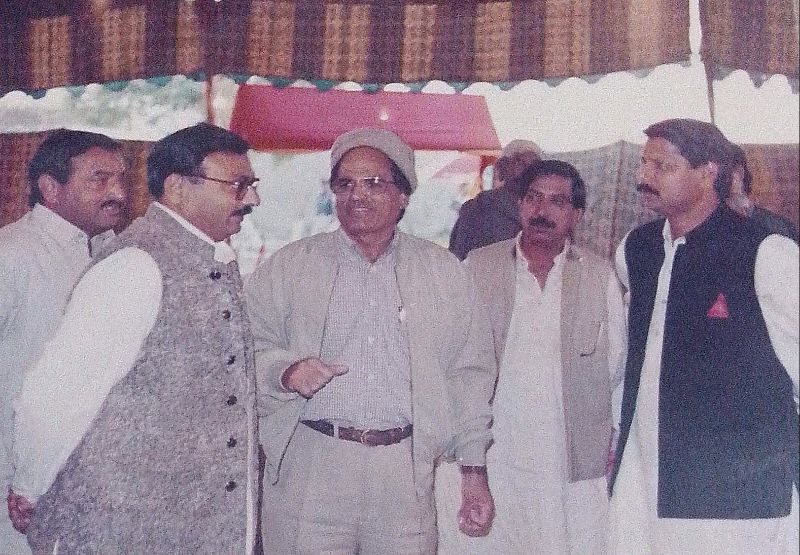
In 1974 he opened a small restaurant in Sakrand, run day to day by his younger brother while Rajput built connections. For four years the restaurant became something of a gathering point for the area's bureaucrats and businessmen, relationships he maintained carefully and that would serve him for the rest of his career. He also ran a cafeteria at the Nawabshah Press Club and cultivated a close working relationship with the local deputy commissioner, who would call on him whenever a VIP passed through — occasions that, more than once, put Rajput in the same room as national figures.
The KMC pool, and the Martial Law Menu
In 1978, a contact from Nawabshah was appointed chief officer of the Karachi Municipal Corporation, and Rajput asked him for a way into the city. The answer was an auction for the right to sell snacks and soft drinks at the KMC Sports Complex swimming pool, which Rajput won for a modest monthly fee. It began, quite literally, with a single wooden chair, a couple of crates of soft drinks and a few packets of chips carried in from Lalukhet. As business grew, he brought in two boys from Nawabshah to help — one of whom, decades later, was still running his kitchens as head cook.
Martial law at the time barred lavish food at weddings, so Rajput improvised a stripped-down "Martial Law Menu" of sandwiches, snacks and cold drinks that proved popular for smaller functions of fifty to a hundred guests. He had almost no capital to put down the deposits vendors required — one local shop owner extended him fifty crates of soft drinks on trust alone, a debt of goodwill Rajput has kept up with the man's family ever since.
“It's a one-window operation. Now you don't even have to worry about damaged or missing items — everything is our responsibility.”
— Hanif Rajput
From a pool-side stall to the city's biggest kitchens
Rajput persuaded Karachi's mayor to allow weddings on the KMC's lawns, generating new revenue for the corporation and steady new business for himself. Through connections made at the Sports Complex, he was introduced to increasingly well-placed patrons. In an odd twist, a provincial governor's displeasure over the untidy cooking site near the pool ended up working in Rajput's favour: he was allotted proper kitchen space near the complex mosque, which grew over the years into the city's largest catering kitchens. His flair for hospitality kept opening doors — a wedding reception for a prominent local family's son in the early 1980s, for instance, went well enough that the family gifted him a pick-up truck at a token price.
Even at his lowest points — hauling vegetables home on his own shoulders in Nawabshah, or starting out in Karachi with nothing but two boys and a few crates — Rajput says he always believed the business would grow into something much larger. By the mid-1990s it had: over 450 people worked for him in Karachi alone, backed by a fleet of roughly 25 vehicles, organising as many as fifty functions a day for clients ranging from modest households to the country's president and prime minister.
The man behind the name
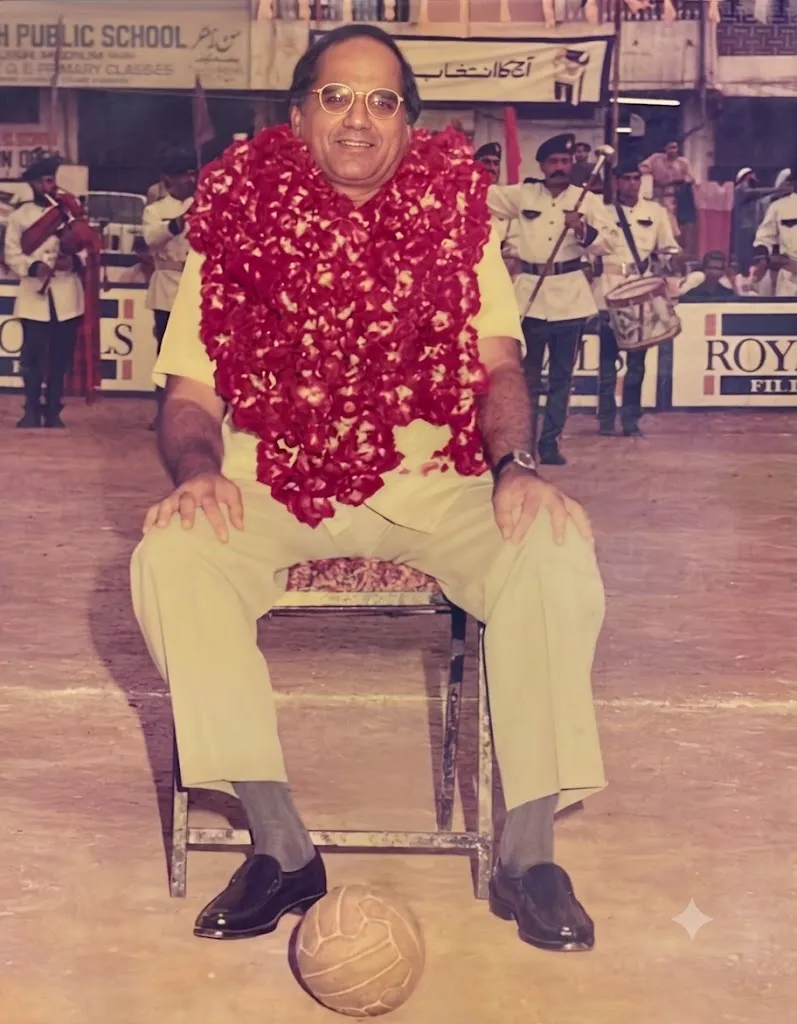
What struck Rajput most, he has said, was passing the old Sakrand Motel signboard years later on his way back from organising a function for the prime minister — a reminder of just how far the business had travelled from where it started. By then his operation catered to everyone from the poorest clients to the most affluent, hosting anywhere from twenty guests to ten thousand, and running a permanent team of consultants to help customers plan. It was Rajput, more than anyone, who pushed the idea that a client shouldn't have to coordinate food, venue, lighting and seating separately — that a caterer should simply take care of all of it.
Even a family crisis didn't slow the business: when his son was kidnapped in 1991, Rajput kept operations running as usual throughout the ordeal, and once his son was safely back, he used the moment to expand the business into Islamabad rather than pull back. Those who worked with him over the years describe someone who never developed the airs of a wealthy man — generous to a fault, reluctant to turn anyone away even when they couldn't pay, and, by most accounts, still the same small-town organiser who once talked his way into a chair by a swimming pool.
Sourced from a profile of Hanif Rajput by Azhar Abbas, published in The Herald Annual, January 1996.